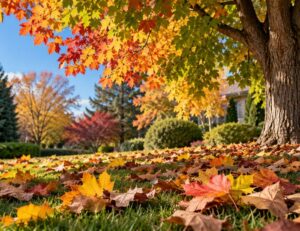

Once leaves begin falling and lawn growth slows, watering often disappears from homeowners’ outdoor to-do lists.
But your trees haven’t suddenly stopped depending on conditions in the soil.
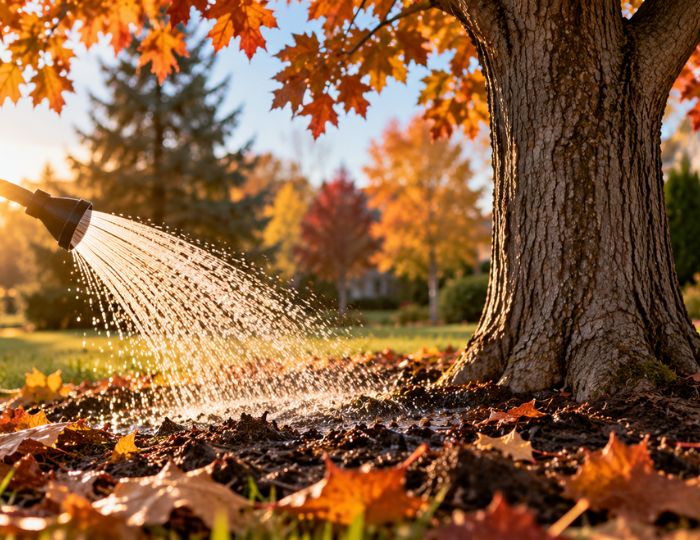
Trees that enter winter after a dry growing season may already be dealing with environmental stress. Depending on weather and soil conditions, supplemental watering before the ground freezes can be an important part of late-season tree care.
At Tree Green, we’ve seen how prolonged environmental stress can affect trees over time. That’s why fall tree care should consider what happened during the entire growing season—not simply how the yard looks in November.
Why Does Soil Moisture Matter Before Winter?
Trees depend on their root systems, and those roots exist in an environment that can change dramatically as temperatures fall.
Adequate moisture before freeze-up can be particularly relevant when fall has been dry or a tree has already experienced drought stress.
This doesn’t mean every tree needs constant watering throughout autumn.
It means homeowners should pay attention to actual conditions rather than assuming cooler weather automatically eliminates a tree’s need for moisture.
Tree Green has previously advised homeowners to consider watering certain trees and shrubs before the ground freezes.
That recommendation becomes especially worth considering after periods of prolonged dryness.
Which Trees May Need Extra Attention?
There isn’t one watering rule that applies identically to every tree.
Tree species, age, establishment, soil conditions, recent rainfall, exposure, and previous stress can all influence what a particular tree needs.
Recently planted or less-established trees deserve attention because their root systems may not yet occupy as much surrounding soil as mature, established trees.
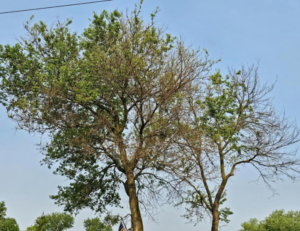
Trees that have shown signs of environmental stress during the growing season may also warrant closer observation.
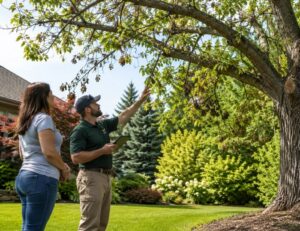
Tree Green offers tree diagnosis when homeowners aren’t sure whether visible symptoms indicate a larger health concern.
Look at the Tree’s Recent History
Think back over the previous spring and summer.
Did the tree develop brown leaf edges?
Did leaves yellow unexpectedly?
Did the canopy appear thinner?
Was the property unusually dry?
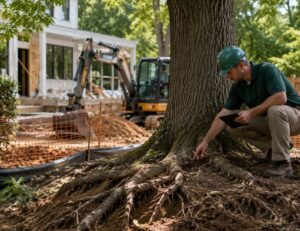
Did nearby construction disturb the soil?
Late-fall decisions make more sense when viewed in the context of what the tree has already experienced.
Why Long-Term Drought Changes the Conversation
A common mistake is assuming that one good rainfall erases an extended dry period.
Tree stress doesn’t necessarily work that way.
Tree Green has previously explained why one rainstorm may not reverse years of tree stress.
We’ve also discussed how years of drought can affect trees and shrubs.
When trees have repeatedly dealt with challenging environmental conditions, it’s important to think beyond short-term appearances.
A tree may still have green leaves or look reasonably normal while experiencing stress that becomes more apparent later.
How Should Homeowners Think About Fall Watering?
The goal isn’t simply to make the soil surface wet.
Tree roots occupy soil below the surface, so effective watering needs to reach the root environment.
At the same time, more water is not automatically better.
Soil type, drainage, rainfall, and the condition of the site matter.
Automatic lawn irrigation also shouldn’t be assumed to provide exactly what trees and shrubs need. Tree Green has discussed how automatic sprinklers can potentially create problems for trees and shrubs.
The important distinction is between intentionally supporting appropriate soil moisture and indiscriminately adding water.
What Does Soil Compaction Have to Do With Water?
Quite a bit.
Soil conditions influence how water and air move through the root environment.
When soil becomes heavily compacted, root health can suffer.
That means tree care can’t always be reduced to “just add water.”
If the underlying soil environment is poor, the tree may face additional challenges regardless of what’s happening at the surface.
Read Tree Green’s guide to soil compaction and tree health for a closer look at this often-overlooked issue.
Should You Fertilize Trees in Fall Too?
Water and nutrients are separate considerations, but fall is an important season for thinking about the overall condition of a tree.
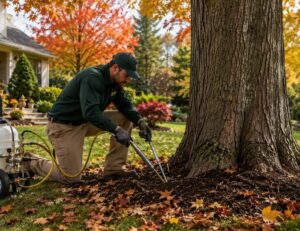
Tree Green provides root fertilization services for trees where professional evaluation indicates that treatment is appropriate.
We’ve also explained why fall can be an important time for tree fertilization.
The key is avoiding a one-size-fits-all approach.
A tree should be evaluated according to its species, condition, environment, and specific needs rather than automatically receiving the same treatment as every other tree on the property.
What If a Tree Already Looks Stressed?
Don’t assume winter will automatically reset the problem.
If a tree showed unusual symptoms during the growing season, fall can be a useful time to document those concerns.
Look for canopy thinning, abnormal coloration, branch dieback, unusual bark conditions, or other changes you’ve noticed over time.
Tree Green’s tree stress recovery services are designed around helping address stressed trees based on their condition.
For broader context, our article about heat and drought stress in trees explains some of the symptoms homeowners may encounter.
When Should You Stop Watering?
Frozen ground changes what you can realistically accomplish through watering.
That’s why the window before the soil freezes matters.
Rather than following an arbitrary calendar date, pay attention to temperatures, soil conditions, and precipitation.
Northern Illinois weather can change quickly, so waiting until the ground is already frozen defeats the purpose of late-season watering.
Tree Green has also discussed how extreme cold in Illinois can affect trees, providing additional context for what trees may face as winter arrives.
Prepare Your Trees for Winter With Tree Green
Healthy trees are long-term investments in a property.
Late fall is an opportunity to think about what your trees experienced during the growing season and whether they are entering winter under additional stress.
If you’re unsure whether a tree needs watering, fertilization, diagnosis, or another type of professional care, Tree Green can evaluate the situation rather than relying on guesswork.
Learn more about Tree Green’s tree-care services or contact Tree Green to discuss concerns about your trees before winter.
Key Takeaways
- Cooler weather doesn’t automatically mean soil moisture is no longer important.
- Fall watering may be worth considering when conditions have been dry before the ground freezes.
- Recently established or previously stressed trees may deserve closer attention.
- One rainstorm doesn’t necessarily reverse the effects of prolonged drought.
- Effective tree watering is about supporting the root environment, not merely wetting the surface.
- Automatic lawn irrigation isn’t necessarily the same as appropriate tree watering.
- Soil compaction can influence root health and the soil environment.
- Tree care should be based on species, site conditions, recent weather, and the individual tree’s health.